
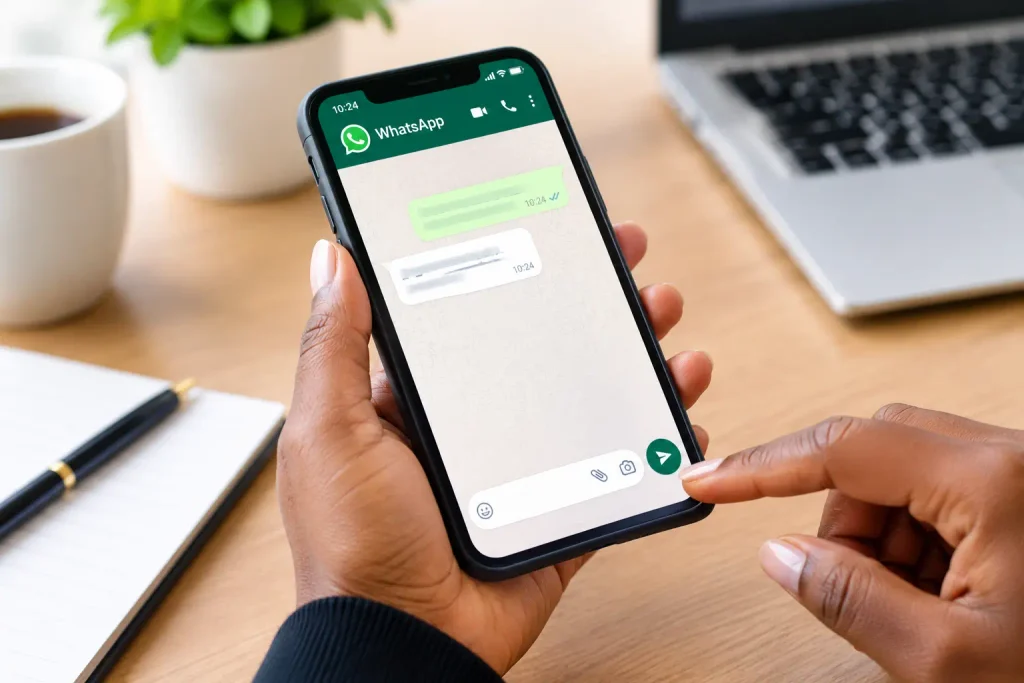
You search for a school, find exactly what you are looking for, visit the website, spot a WhatsApp number and think, Bingo! I don’t have to make another phone call.
You send your question.
Then you wait.
One grey tick.
You check again.
Still one grey tick.
By the end of the day, you are no longer wondering only about the answer to your question. You are wondering whether the number works at all.
This is where customer expectations on WhatsApp begin.
Today, your customer may discover your business on Google, visit your website, watch your Facebook Reel and then reach you on WhatsApp. To them, these are not separate experiences. They are all part of one customer journey.
And I recently found myself on exactly that journey.
My Search for a School Started on Google
I was recently searching for a school for my child in a different town because I was considering relocating.
I searched Google and several schools came up. Fortunately, I had a contact in the area who mentioned a school that was close to the location where I intended to move.
I searched for it among the results.
There it was.
Bingo!
At least I didn’t have to go through every school on the list.
I checked whether the school had a website. It did.
Then I noticed something else: they had a WhatsApp contact.
Even better.
I could ask about the fee structure without making a trip or calling someone during a busy moment.
So I sent my message.
Then I waited.
One Grey Tick Can Create Many Questions
I kept checking WhatsApp.
One grey tick.
The message had not been read.
As the day went on, I started asking myself questions.
Is this number working?
Are they actually active on WhatsApp?
Do they still use this number?
Then I went back to their website.
The website looked active. I could also see that their Facebook page had recent pictures and Reels showing activities at the school.
So the business clearly had an online presence.
But my WhatsApp message was still sitting there unread.
And that is where something interesting happens in the customer’s mind.
Silence creates uncertainty.
I had not decided that the school had poor customer service. I didn’t know what was happening on their side.
Perhaps the person responsible for WhatsApp was away.
Perhaps they were busy.
Perhaps it wasn’t office hours.
Perhaps nobody had checked the phone.
I didn’t know.
But as a customer, I had already started thinking about my alternatives.
The Customer May Not Wait Forever
By the following day, I was already thinking about what I would do next.
I could look for another school.
That wasn’t what I wanted because this school was conveniently located near where I hoped to relocate.
Or I could use my contact in the area to get the fee structure for me.
I was almost reaching for my phone to contact that person when I saw a WhatsApp message.
It was from the school.
They apologised and explained that the person handling the matter had not been in the office the previous day.
Then they sent me the fee structure.
And true to their word, when I had more questions, they answered them appropriately.
Suddenly, the story changed.
The delay had not disappeared.
But the explanation changed how I experienced the delay.
That is an important customer-service lesson.
Customers Expect Communication, Not Perfection
Businesses sometimes assume that good customer service means responding immediately to every message.
That is not always realistic.
People go home.
Phones run out of charge.
Staff members are away from the office.
Some questions require information from another department.
And sometimes, there simply isn’t anyone available to respond immediately.
Customers understand that.
What becomes frustrating is not knowing what is happening.
Research into customer-service expectations consistently points to customers wanting to feel heard and valued, have an easy process, receive action and get reasonably quick responses.
That means a business does not necessarily have to provide an instant solution.
But it should think about how it communicates while the customer is waiting.
A simple message such as:
“Thank you for reaching out. We have received your message and will get back to you as soon as possible.”
can already change the experience.
Even better:
“Thank you for reaching out. Our office is currently closed, but we will respond when we reopen tomorrow.”
Now the customer knows what to expect.
So, What Do Customers Expect on WhatsApp?
1. They Expect the Number to Be Active
When you put a WhatsApp number on your website, customers assume it is there for a reason.
They expect someone to monitor it.
If you are going to advertise WhatsApp as a customer-contact channel, make sure someone is actually checking it.
Otherwise, the number becomes a promise you aren’t keeping.
2. They Expect a Reasonable Response
Reasonable does not always mean immediate.
A customer asking about school fees may understand that you need to check the current fee structure.
Someone asking whether a product is available may understand that you need to confirm stock.
The problem comes when there is complete silence.
Research on digital customer service shows that expectations around response speed are high, although the appropriate response time varies by channel and situation.
The lesson for a small business is simple:
Know your expected response time and communicate it.
3. They Expect an Answer to the Question They Asked
Have you ever sent a business a question and received a reply that doesn’t actually answer it?
You ask:
“How much is this dress?”
The response:
“Hello dear, welcome.”
Lovely greeting.
But you still don’t know how much the dress costs.
Customer service is not just about being polite.
It is about being useful.
If the customer asks for a fee structure, send the fee structure.
If they ask whether an item is available, check.
If you don’t know, say so and tell them when you will find out.
4. They Expect Not to Repeat Themselves
Imagine sending a detailed message explaining what you need, only to receive:
“Please explain.”
You explain again.
Then:
“Which class?”
You answer again.
Then:
“Which campus?”
At some point, the customer starts feeling like they are doing the work for the business.
Good digital customer service should reduce friction, not create more of it.
Customers increasingly value convenient communication and experiences that feel easy rather than complicated.
5. They Expect Courtesy
WhatsApp may feel informal.
It is still a customer-service channel.
That means:
Please.
Thank you.
You’re welcome.
I’m sorry for the delay.
Let me check that for you.
These small phrases matter.
I wrote more about this in Customer Etiquette at the Front Desk, because good customer etiquette doesn’t disappear simply because the interaction has moved from a physical counter to a phone screen.
6. They Expect Follow-Through
This may be one of the most important expectations of all.
If you tell a customer:
“Let me check and get back to you.”
Get back to them.
If you say:
“I’ll send the price list this afternoon.”
Send it.
If you promise to call tomorrow, call tomorrow.
A customer doesn’t only remember the answer you gave.
They remember whether you did what you said you would do.
What About When You Can’t Respond Immediately?
This is where businesses can make a huge difference without needing expensive technology.
You don’t have to pretend you are available 24 hours a day.
Instead, set expectations.
You could have an automatic message saying:
“Thank you for contacting us. Our WhatsApp messages are monitored between 8 a.m. and 5 p.m. Monday to Friday. If you message us outside these hours, we’ll respond when we’re back.”
Now the customer knows.
You could also use a simple acknowledgement:
“Thank you for your message. We’ve received your enquiry and will respond shortly.”
That tiny message can prevent a customer from wondering whether their enquiry disappeared into cyberspace.
WhatsApp itself provides business tools designed to help businesses communicate with customers, making it worth considering how deliberately you use the channel rather than simply placing a WhatsApp number on your website. WhatsApp Business
And What Happened With My School Search?
The school eventually answered me.
They apologised.
They explained why there had been a delay.
They sent the information they promised.
And when I had additional questions, they answered them properly.
That experience reminded me of something I often say about customer service:
Customers don’t always expect everything to go perfectly. They want to know that someone is paying attention.
The school could not change the fact that I had waited.
But they could change what happened next.
And they did.
Their response gave me enough confidence to continue considering the school instead of immediately moving on to another option.
That is the power of communication.
Your WhatsApp Number Is Part of Your Customer Experience
If your website says:
“Chat with us on WhatsApp”
your customer has already been given an invitation.
They have accepted it.
They have taken the next step.
Now what happens?
Do they receive an answer?
Do they know when to expect one?
Does someone read their message?
Does the response answer their question?
Does the conversation make it easier for them to choose your business?
Or does the customer send a message and disappear into silence?
Your online customer experience does not begin when you answer the message.
It begins the moment the customer decides to trust your business enough to reach out.
And if you want to understand why these little interactions matter so much, take a look at How Social Media Customer Service Builds Trust.
Because that WhatsApp message may look like just another enquiry in your inbox.
To the customer, it could be the beginning of a purchase, a school admission, a booking, a partnership or a decision about whether your business is worth trusting.
The question for your business is simple:
When a customer sends you a WhatsApp message today, what experience are you giving them before you even say hello?
A Final Reflection
That school search taught me something beyond the fee structure I was looking for.
I had choices.
I could wait.
I could look for another school.
I could ask my contact.
The business did not know all the alternatives I had.
And your customers are the same.
You may not know how many other options they have.
That is why every WhatsApp message deserves attention.
Not because every message will become a sale.
But because every message represents someone who has taken the trouble to knock on your digital door.
Will someone answer?
Call to Action
If you run a business, check your WhatsApp today.
How long would a new customer wait before receiving a response?
Do you tell customers when you’re unavailable?
Do your replies actually answer their questions?
And if you are a customer, tell me:
What do you expect when you send a business a WhatsApp message?