Category: Customer Care

“Reflections and lessons from behind the desk — in clinics, churches, firms, and more.”

  • When Opportunity Knocks in Life: A Lesson in Service

    Blog post featured image with the title "When Opportunity Knocks in Life: A Lesson in Service" and subtitle "Reflections on missed chances, quiet service, and preparing for the moments that matter," displayed on a textured off-white background in clear, bold typography.

    When opportunity knocks in life, it doesn’t always come with noise or neon signs. Often, it arrives quietly—through a need, a gap, or a simple question. One Sunday morning in church, I encountered such a moment. It wasn’t dramatic or public, but it left a deep impression on how I view service, readiness, and personal growth.

    That moment also mirrored what I’ve been learning as a blogger: that growth and impact come in small, faithful steps. Whether in faith, creativity, or relationships, we must learn to recognize and respond when opportunity comes knocking.


    A Silent Call in Church

    That morning, the church was slowly filling up. Among the congregation were our regular deaf brethren, who are faithfully served each week by volunteer interpreters. In fact, there’s always a standing offer for free sign language classes after the first service—open to anyone interested.

    However, that Sunday was different. The interpreters hadn’t yet arrived.

    The pastor stepped forward and asked a simple but weighty question:

    “Is there anyone here who can interpret for our deaf brethren?”

    At first, no one moved.
    A hush fell over the room.
    Glances shifted but hands remained still.

    Although several people had been invited to learn over time, none of us—including myself—had taken the opportunity seriously. As a result, when the moment came to serve, we were all unprepared.

    A quiet church interior with a single wooden chair in soft light, symbolizing readiness when opportunity knocks quietly in life.

    When Opportunity Knocks in Life, Will You Be Ready?

    That brief moment revealed a powerful truth: when opportunity knocks in life, it doesn’t wait for you to go home and get ready. It shows up on an ordinary morning, asks a quiet question, and expects someone to step in.

    This wasn’t a dramatic miracle or a divine prophecy. It was a simple need—for someone who could sign, someone who could bridge two worlds through their hands. And sadly, not one of us had the training.

    I sat in my seat reflecting, not with guilt but with clarity. That moment reminded me of how often we pray for purpose, direction, and open doors—yet fail to prepare for the very doors God is trying to open.


    Missed Opportunities Are Often Uncomfortable

    We tend to associate opportunity with comfort, excitement, and breakthrough. However, real opportunities often arrive disguised as inconvenience or responsibility.

    For instance, no one wants to be called upon unexpectedly. Yet, in that moment, the church didn’t need another sermon or song. It needed someone with the skill to interpret. Someone with a willing heart and prepared hands.

    That moment made me think: How many other silent cries have we missed because we weren’t ready?


    Blogging and Ministry: Parallel Lessons

    Interestingly, this revelation came at a time when I was also struggling with my blog. I thought I had finally figured out the basics of SEO—meta descriptions, slugs, key phrases. But then came the technical errors: redirects, “no index” alerts, canonical mismatches. It felt like I was back to square one.

    Even so, I kept posting. I recently started sharing on Pinterest, hoping to earn a bit of affiliate income from Amazon. After three months, I received only two clicks from Google Search. But those two clicks meant someone, somewhere, found value in my work.

    That’s when I realized: faithfulness in small things matters—whether in blogging or church service. The results may be slow, but they come.


    How to Prepare Before the Door Opens

    Rather than wait for opportunity to knock loudly, we can choose to equip ourselves quietly. Preparing doesn’t always require big changes. Sometimes, it’s about saying yes to the next small step.

    For example, I’ve decided to finally attend those sign language classes. I want to be ready the next time help is needed. Likewise, I’m also continuing to learn about SEO and content creation—even when growth feels slow.

    You don’t have to be perfect. You just have to be willing to grow.


    Affiliate Resources to Help You Prepare

    Here are a few tools that have helped me—and could help you, too—as you prepare for moments when opportunity knocks in life:

    📘 Start Learning Sign Language
    👉 Sign Language for Beginners: A Step-by-Step Guide (affiliate)

    📔 Track Growth and Spiritual Goals
    👉 Christian Daily Journal – Guided Devotional Planner (affiliate)

    💻 Start a Blog or Digital Ministry
    👉 Start a Successful Blog in One Hour (affiliate)


    Simple Actions That Build Readiness

    Here are a few ways to prepare for opportunity:

    • Take a class – something practical like sign language, writing, or public speaking
    • Write regularly – whether on a blog or in a journal
    • Volunteer in small areas – sometimes cleaning or ushering opens greater doors
    • Stay open to feedback – growth comes through correction
    • Celebrate the little wins – two clicks are better than none

    Each action adds up. Each seed planted today may bloom into purpose tomorrow.


    When God Sends Quiet Invitations

    One powerful takeaway from that Sunday is this: God’s opportunities often come as quiet invitations, not loud demands. They’re embedded in everyday life—church, work, community, online platforms.

    “Whoever can be trusted with very little can also be trusted with much.” – Luke 16:10

    Opportunities are tests of faithfulness. They may look like learning a skill, being available, or simply responding to need when it arises.

    Whether you’re building a blog, mentoring youth, interpreting for the deaf, or running a home business—be available for the moments that matter.


    Helpful Outbound Links


    Related Posts on Lobby Reflections (Internal Links)

    📌 The power of blending technology with human care
    📌 📌 My Blogging Journey


    Conclusion: Be Found Ready

    The next time someone asks, “Can anyone help?”—whether in church, at work, or online—don’t let the moment pass you by.

    When opportunity knocks in life, be found ready.

    You don’t have to be the best. You don’t have to be famous. You just have to be available—and willing to use what’s in your hand.

    Start today. Prepare quietly. And trust that the doors will open in due time.

  • Customer Care Stories from Kenya: Clinic & Loan Drama

    Introduction: Real Customer Care Stories from Kenya

    Customer care stories from Kenya are more than routine service encounters—they are windows into real lives, emotions, and sometimes secrets. Working behind desks in clinics and microfinance offices has taught me that listening is more than a skill—it’s a survival tool. From NHIF shocks at the front desk to loan drama in financial offices, every moment behind the counter has been a classroom in human behavior.

    Customer Care Stories from Kenya: NHIF Drama at the Clinic Desk

    In the private clinic where I worked, we often asked patients to add their partners as dependents under NHIF. Back then, the process required a marriage certificate or affidavit as proof of relationship.

    📝 Note: Since the transition to the Social Health Authority (SHA), these documents are no longer required for registration.

    One day, a woman came in confidently with her husband and their marriage certificate. She wanted to list him as a dependent. I logged into the system and keyed in the man’s ID.

    To our surprise, he was already listed under another account. The name attached wasn’t hers—it was another woman.

    “Who is Achieng?” she asked quietly.
    “There must be a system error,” he mumbled.

    It wasn’t a system error. It was a reality check.

    In that moment, the clinic turned from a place of care to a battleground. I stayed calm, gave them space, and stuck to my role—guiding, not judging.


    What Clinic-Based Customer Care Stories Reveal About Relationships

    The NHIF-SHA system is meant to provide universal health coverage—but it also inadvertently exposes secrets. A customer care agent must be emotionally intelligent to handle such sensitive discoveries.

    If you’re interested in learning more about current SHA registration policies, visit the NHIF SHA FAQ page.


    Microfinance Meltdowns – When Loans Are Taken in Secret

    Another unforgettable example came from my time in a Kenyan microfinance institution. Many women took loans without their spouses’ knowledge—sometimes out of desperation, other times from ambition.

    One woman borrowed Ksh 30,000 for her small shop. When she defaulted on repayments, we reached out to her emergency contact—her husband.

    The next day, he stormed into the office.

    “Why would you give her money without asking me? I’m the head of this house!”

    She sat silently, eyes on the floor.

    “Sir,” I explained gently, “she qualified independently and signed all the documents.”

    The tension was thick. Other clients were watching. My job was to protect both the institution and the dignity of the clients.


    Listening as a Shield in Conflict

    In such moments, listening is your shield. It allows you to de-escalate, remain neutral, and gather facts without becoming emotional. I never forget that behind every default, there’s a story.

    These customer care experiences in Kenya have taught me the value of soft skills in tough moments.


    Tools That Help You Stay Professional Under Pressure

    Whether you’re handling insurance claims or financial disputes, the right tools help you stay composed and organized. Here are some Amazon picks I’ve found helpful:


    📝 Lockable Journal – For documenting sensitive interactions
    🔗 View on Amazon

    🎧 Noise-Cancelling Earbuds – Great for confidential calls or follow-ups
    🔗 View on Amazon

    📘 The Power of Listening by Lynne Baab – An excellent read for customer service professionals
    🔗 Buy on Amazon

    💼 Professional Desk Divider – Helps maintain privacy in shared service desks
    🔗 Check it out here


    Customer Care Isn’t Just a Job—It’s Emotional Labor

    What makes customer care in Kenya uniquely complex is the mix of cultures, expectations, and economic pressures. Clients don’t always follow rules. Emotions run high. But if you listen well, you can navigate even the stormiest situations.


    H3: Key Lessons from the Front Desk

    💡 Don’t take sides – Even when you know who’s wrong, stay professional.
    💡 Let the client save face – Avoid public embarrassment; offer privacy when possible.
    💡 Know the policy – Be updated on current NHIF/SHA and financial institution regulations.
    💡 Document everything – Especially in emotionally charged scenarios.


    Internal Link Suggestion

    👉 Handling Unstable Customers in Customer Care

    This post expands on what to do when clients react emotionally—something I’ve dealt with both at clinics and finance desks.


    Final Thoughts – Listening Opens the Door to Understanding

    These real customer care experiences in Kenya have left lasting impressions on me. Sometimes I was shocked. Other times, I was heartbroken. But always, I came out more compassionate.

    Behind every request is a story. Behind every angry customer is often a scared one. And behind every secret… is a person who thought they’d never be found out.

    If you work in customer care—or hope to one day—remember this:

    Your ears are your strongest tool. Use them with wisdom and grace.

  • Faith and Customer Care in Sales: A Lesson from the Insurance Field

    "Illustration of a respectful sales conversation between two people, with symbols of Christianity, Islam, and Hinduism representing faith and diversity in customer care."

    Every sales pitch teaches you something—but not always about money. Sometimes, it’s about people, values, and how deeply faith and customer care in sales are connected.

    Years ago, I was selling a car insurance tracking service—911 Car Track—for about three weeks. It was my first real experience with a product that required not just explanation, but persuasion. The deal also came bundled with life insurance, which I thought was a major selling point.

    One man listened patiently as I outlined all the benefits: peace of mind, compensation, and security. Then he smiled gently and asked,

    “Why should I anticipate bad things? Shouldn’t I live by faith instead of fear?”

    His words stayed with me long after I walked away without a sale. It was my first deep lesson in faith and customer care in sales—a lesson on how belief systems shape buying behavior.


    Understanding Faith in Sales: More Than Just a “No”

    When the customer brought up faith, he wasn’t dismissing me or mocking the product. He simply saw the world through a different lens—one of trust in God, not fear of bad outcomes.

    As someone trying to make a sale, I initially felt thrown off. But looking back, I realized that this was more than just a “no.” It was an invitation to understand how faith shapes decisions, and how that must inform the way we approach customer care.

    According to Gallup’s Strengths-Based Leadership research, leaders often instill hope and use terms like “direction, faith, and guidance” to guide their teams—and this same framework applies to customer conversations rooted in respect and trust gallup.comgallup.com+1mycontent.gallup.com+1


    Why Faith and Customer Care in Sales Go Hand in Hand

    1. Faith Influences Risk Perception

    Some customers believe that protection comes from divine sources, not financial plans. This doesn’t mean they’re naive; it means they have a different risk framework.

    As a seller, you must ask: Am I addressing real fears, or selling fear?

    🔗 Faith-Based Decision Making in Business (Amazon)


    2. Cultural Sensitivity Matters in Sales Conversations

    I’ve also seen this in other settings:

    • Muslim customers politely declining pork-based products.
    • Hindu clients avoiding meat altogether, no matter how good the offer.
    • Christians who prefer to avoid fear-based marketing altogether.

    This kind of diversity means we can’t apply a one-size-fits-all script. Faith and customer care in sales demand emotional intelligence, cultural sensitivity, and respect.

    ➡️ Handling Unstable Customers in Customer Care – Kenya

    A study on religious values notes that religion influences consumer choices, such as Muslims avoiding pork and Hindus avoiding beef myscp.onlinelibrary.wiley.com+2en.wikipedia.org+2myscp.onlinelibrary.wiley.com+2.


    3. Care Means Seeing Beyond the Transaction

    That insurance customer didn’t just reject the product—he left me with a new mindset. In that moment, I wasn’t a salesperson. I was a fellow human being in conversation with another, each of us guided by something deeper than price tags and policies.

    🔗 The 5 Love Languages of the Workplace (Amazon)


    Faith and Customer Care in Sales Builds Trust Across Boundaries

    You don’t have to share a customer’s beliefs to respect them. In fact, one of the greatest compliments I’ve received was from someone who said,

    “I didn’t buy, but I’d definitely refer someone to you.”

    That kind of feedback is a result of customer care built on respect, not pressure.


    Lessons for Anyone in Sales or Service

    Ask Before You Pitch

    Get a sense of your customer’s worldview. Even a simple “What matters most to you when buying insurance?” can lead to a meaningful exchange.

    Respect Cultural Boundaries

    Avoid products or language that may conflict with a customer’s values.

    Be Present, Not Pushy

    Sometimes the best sale is no sale at all—just a moment of connection and understanding.


    Faith in Customer Care is Good Business

    Respecting beliefs isn’t just moral—it’s strategic. In diverse settings like Kenya, where faith is woven into daily life, customers remember how you made them feel more than what you offered.

    Even today, as I sell deras, run my book lending side hustle, or write for Lobby Reflections, I carry that same principle:
    Faith, dignity, and genuine care never go out of style.

    ➡️ Serving in Church Behind the Scenes

    🔗 Doing Business by the Good Book (Amazon)


    Final Word: Serve the Person, Not Just the Need

    As we grow in our businesses—whether hawking products, offering services, or blogging—we must keep asking:

    “Am I seeing the customer, or just seeing a sale?”

    Faith and customer care in sales is about more than belief systems. It’s about embracing the full humanity of the people we serve—and honoring them accordingly.

    As Clearly Reformed explains, “Perfect love casts out fear”, and the adage “faith over fear” is deeper than a slogan—it’s about trusting God’s sovereignty amid uncertainty clearlyreformed.org

    Call to Action

    Have you ever had to adjust your approach because of a customer’s faith or cultural background? Share your story in the comments or inbox me—I’d love to learn from your experience.

  • Grief and Duty in Customer Care in Health Clinics Kenya

    African woman in emotional distress, reflecting the quiet grief faced in customer care roles at health clinics in Kenya.

    Photo by Pixabay on Pixabay

    Grief and Duty in Customer Care in Health Clinics Kenya

    Working behind the reception desk of a health facility can feel routine—until it’s not. Customer care in health clinics Kenya isn’t just about booking appointments or filing records; it’s about facing the raw emotions that patients bring with them. My time at a small Kenyan clinic showed me that sometimes, grief, fear, and hopelessness walk through the door long before a doctor enters the room.


    Customer Care in Health Clinics Kenya: More Than Just a Desk Job

    At this particular clinic, we handled patients seeking routine care, checkups, and HIV services. Some would walk in silently, heading straight to the doctor without uttering a word. They were regulars—those already diagnosed and coming in for medication. I had been trained to recognize their rhythm and offer subtle, non-intrusive support.

    Then there were the ones who came in for HIV testing. They came as individuals or couples, visibly anxious. After pre-test counselling, they would go through the procedure and then await their results with a tension you could almost touch. The emotional intensity in those moments was something you never get used to.

    And still, others—mostly young girls, students—would come in seeking abortion services, which the clinic did not offer. Telling them “we can’t help” was always a hard conversation, one that required a delicate mix of firmness and compassion. Each case felt like a reminder that people bring more than just symptoms when they visit a health facility—they bring their entire stories.


    A Tragedy That Still Haunts Me

    Among all the encounters, one still breaks my heart.

    A woman used to visit the clinic regularly. She seemed pleasant but reserved. I had spoken with her a few times—light chat at the desk, nothing too deep. One day, she came in for an HIV test. When the results came in, she was asked to return with her partner.

    She never did.

    The next day, we heard that she had thrown herself in front of an oncoming vehicle along the highway near her home. She died instantly. The shock in the clinic was palpable. It wasn’t just that we’d seen her the day before—it was that we hadn’t seen the signs.

    That grief stayed in the room long after she was gone.


    Even Caregivers Need Care: Another Heartbreaking Loss

    What made that period even heavier was losing one of our own.

    One of the nurses—who was married and responsible for counselling HIV-positive patients—tested positive herself. She knew the systems, the medication, the science. But she couldn’t accept it.

    She withdrew completely, stopped coming to work, and eventually shut herself off from everyone. She wouldn’t open her door to friends or colleagues. By the time opportunistic infections caught up with her, it was too late.

    Her death revealed something sobering: being in a place of information doesn’t mean you are immune to despair.


    Coping with Emotional Weight in Customer Care in Health Clinics Kenya

    As a frontline worker, you end up absorbing a lot—sometimes too much. And unlike clinical staff, receptionists and front desk workers often lack professional training in emotional resilience or trauma handling.

    You’re expected to stay composed, kind, and efficient, even when someone is breaking down in front of you.

    📍 Also read: Handling Unstable Customers: My Experience in Customer Care

    Here are a few tools that helped me cope:


    🧠 Journaling for Mental Clarity

    Writing gave me a safe space to release the heaviness of the day.
    👉 Guided Therapy Journal on Amazon


    🎧 Tuning Out for a Moment of Peace

    During lunch or tea breaks, I’d plug in my earphones and breathe.
    👉 Top-Rated Noise Cancelling Headphones – Amazon


    📚 Reading to Understand and Heal

    Books gave me insight into emotional intelligence and how grief affects behavior.
    👉 Emotional Intelligence by Daniel Goleman


    Lessons I Carry to This Day

    This experience taught me that customer care in health clinics Kenya is about so much more than polite greetings and appointment slips. It’s about quietly holding space for life-altering moments—both joyful and tragic.

    It showed me that even people with full knowledge can be undone by fear, and that sometimes, the listener also needs someone to listen to them.


    Resources for Mental Health and HIV Support in Kenya

    If you or someone you know is struggling, please don’t stay silent. Support is available:


    Final Thoughts

    Working in customer care in health clinics Kenya taught me that pain doesn’t knock before entering. It sits across from you, fills the room, and sometimes walks out without healing. If you’re in this line of work, I see you. And I honour your quiet courage.

  • My Blogging Journey with Zero Motivation

    Illustration of a frustrated blogger sitting at a desk with a notebook and laptop, symbolizing zero motivation and blogging struggles.

    When I first started blogging, I was full of excitement. I had stories to tell, experiences to share, and a dream to make money online. But now—months in—I find myself grappling with zero motivation.

    Trying to get more traffic feels like climbing a steep hill barefoot. Some days I wake up ready to conquer SEO and the world; other days, I stare at my blog stats and wonder: Does blogging even work?


    The Challenge of Blogging with Zero Motivation

    I’ve done the work—or so I thought. I’ve learned the basics of SEO:

    • How to write optimized titles
    • Structure posts with H2 and H3 headings
    • Write meta descriptions
    • And chase that elusive LCP (Largest Contentful Paint)

    But that LCP? Some mornings it’s okay. Then, out of nowhere, I get a 7.6s score and I’m left wondering if it’s me—or the internet gods testing my patience.


    Why Zero Motivation Creeps In

    One of the reasons zero motivation hits me so hard is because of the time and effort I’ve put into things like affiliate programs, without clear results.

    I signed up for Amazon’s Affiliate Program with hopes of making commission. But being in Kenya, it’s not easy.
    I tried registering for local affiliate programs, but many return errors or are always “under maintenance.” And customer service? Practically unreachable.


    AdSense, Traffic Drops, and Zero Motivation Moments

    Just when I thought I was gaining ground, I was rejected by Google AdSense. Apparently, my site didn’t meet the requirements. I planned to revisit that, but again—it all comes down to traffic.

    At one point I had 58 visitors. I was thrilled—only for the numbers to start dropping. I didn’t even know that was possible. Seeing traffic decline is crushing—and a sure trigger for zero motivation.


    Pushing Past Zero Motivation to Learn Promotion

    I’ve been sharing posts on:

    • LinkedIn
    • My Facebook Page
    • WhatsApp

    But I soon realized: these are mostly seen by people in my circle. LinkedIn has potential, but boosting needs money—and I don’t have that right now.

    Then I discovered TikTok. It’s powerful, but now I have to learn CapCut and Canva. Another journey. Another reason to get overwhelmed.


    Rewriting and Redirects: Hidden Blogging Work

    I also started receiving messages about redirect issues on my blog. Turns out I’d been structuring URLs poorly. So I’ve had to go back and fix posts—rewriting and correcting links I didn’t know were broken.


    A Race Against Time: My Amazon 180-Day Deadline

    Right now, the clock is ticking. I need to make at least one Amazon sale within 180 days to stay in the affiliate program.

    That’s how I got into Pinterest and found it surprisingly responsive. The same with TikTok. Both seem to have global potential. Now I’m exploring Reddit too—because the Kenyan market alone won’t cut it.


    Final Thoughts: Zero Motivation, Big Dreams

    This blogging journey has been overwhelming. The tech, the traffic, the monetization—it’s a lot. And zero motivation keeps knocking.

    But I’m not giving up. My goal is to earn something—anything—this month. Just a small breakthrough to remind me it’s possible.

    If you’re reading this and feel like you’re drowning in SEO, platforms, plugins, and stats—please know you’re not alone.

    Let’s keep going. Even with zero motivation, we can still take the next small step.


    Internal Links:
    👉 Handling Unstable Customers in Customer Care
    👉 Affordable Office Essentials Kenya: Creating a Functional Workspace

    Outbound Link:
    📘 Learn more about Amazon Affiliate Requirements

    Amazon Affiliate Suggestion:
    Create your content in style with this tool I’m eyeing:
    Ring Light with Tripod Stand for TikTok, Zoom & YouTube (affiliate link)

  • Creating a Functional Workspace on a Budget

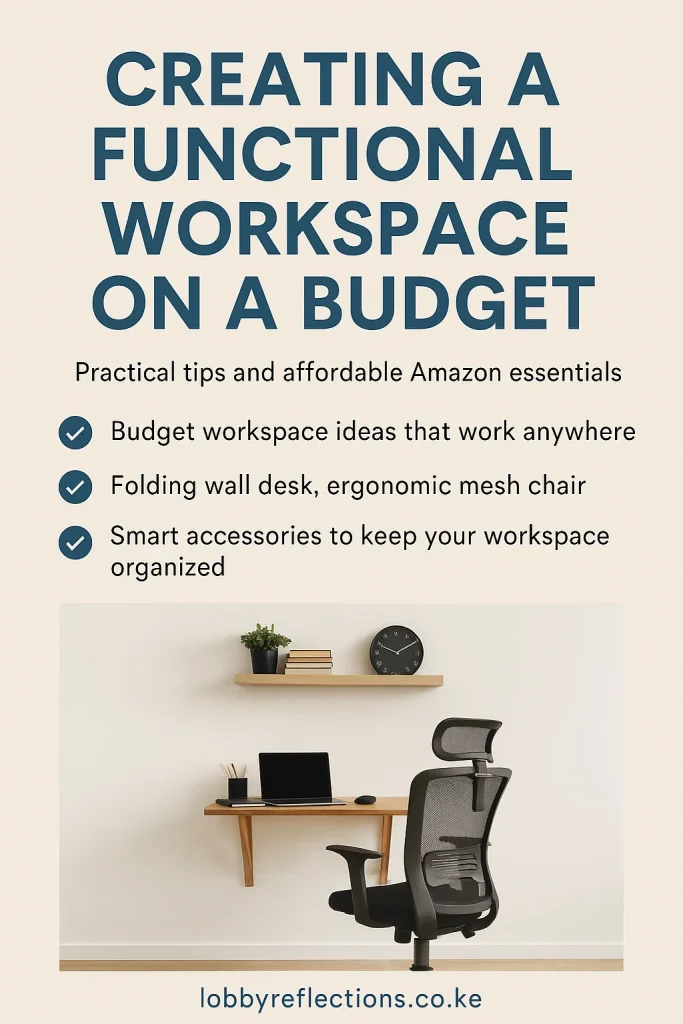
    “Minimalist home office with laptop, ergonomic chair, and budget-friendly accessories — ideal for creating a functional workspace on a budget.”

    Creating a functional workspace on a budget is possible no matter where you live or work. Whether you’re in a shared Nairobi apartment, a London bedsit, or a bustling family home in Manila—affordable upgrades can make a big difference. This post shares practical tips and budget workspace ideas that work anywhere, with Amazon picks that ship globally.


    Why a Functional Workspace on a Budget Matters

    Having a proper setup can truly elevate your productivity. Specifically, it:

    • Boosts focus, helping you minimize distractions
    • Improves posture and health through better ergonomics
    • Inspires consistency, creativity, and professionalism

    Even better, you don’t need a designer studio or a large budget. With a few intentional choices and small investments, you can build a space that motivates you to get things done.


    How to Choose a Functional Workspace on a Budget

    Fortunately, you don’t need an extra room to work from home. In fact, many people start with:

    • A corner in their bedroom
    • A shared dining table with a moveable divider
    • A repurposed closet (a.k.a. “cloffice”)

    📌 Pro tip: Use soft rugs, adjustable lighting, or artwork to visually define your workspace—even in tight, shared areas. That way, your brain begins to associate that space with productivity.


    Budget Furniture That Works for a Functional Workspace

    Folding Wall Desk – Great for Small Spaces

    This desk is a smart choice if space is limited. It folds flat when not in use, which helps save room in multifunctional areas.

    Ergonomic Mesh Chair – Budget-Friendly Comfort

    While affordable, this chair still provides essential lumbar support and comfort for long work sessions. As a result, you’re less likely to experience back strain.


    Smart Accessories to Keep Your Workspace Organized

    Desktop Organizer with Drawers

    A clutter-free desk improves focus. In addition, this small unit keeps all your tools, pens, and gadgets in one place.

    Cable Management Box

    Tidy cables make your workspace look and feel more professional. Also, it reduces the risk of accidents caused by tangling wires.

    📌 Want even more budget-friendly ideas? Check out: Affordable Office Essentials for Remote Workers


    Create Comfort Without Breaking the Budget

    Personalizing your space doesn’t require a big spend. Consider adding:

    • A soft throw blanket or cushion
    • Scented candles or a small diffuser
    • A wall calendar or inspirational poster

    Motivational Wall Art Set

    Not only that, adding visuals you love can improve your mood and reduce stress during long hours.


    Best Budget Tech for a Functional Workspace

    Tech tools don’t have to be high-end to be helpful. For example, the options below are practical and affordable.

    Mini Whiteboard for Daily Goals

    You can track your tasks and reminders while avoiding digital overload.

    Wireless Keyboard & Mouse Combo

    This combo is sleek and helps declutter your desk. In addition, it improves your workflow by eliminating tangled cords.

    Laptop Stand with Adjustable Angles

    This tool improves posture and airflow. Therefore, your laptop stays cool and your body stays aligned.

    Noise-Cancelling Headphones (Budget Edition)

    Whether you’re working in a noisy apartment or during your kids’ school breaks, these help maintain concentration.


    Budget vs Premium: When to Splurge and When to Save

    Choosing what to invest in depends on what you use most.

    💰 Splurge on:

    • A high-quality chair — your back will thank you over time
    • Good lighting — especially important for long evening hours
    • A comfortable keyboard and mouse — they make everyday tasks more pleasant

    💸 Save on:

    • DIY organizers — upcycle jars, tins, or shoeboxes
    • Digital tools — free apps can often replace paid ones
    • Second-hand desks — many offer great value for less

    Ultimately, your goal is to stay comfortable and organized without overcommitting financially. And remember, starting small is better than not starting at all.


    Real-Life Example: My Budget Workspace Setup

    When I began blogging seriously, I had no home office—just a plastic chair and my kids’ old school desk. However, I made a few changes: I bought a second-hand table for Ksh 400, added a clip-on lamp, and used a laptop stand.

    Since then, my productivity has grown. That small corner is now where I write blog posts, brainstorm content, and even manage client work. Truly, you don’t need fancy—just functional.


    FAQs: Building a Functional Workspace on a Budget

    Can I set up a workspace without spending anything?
    Yes! Repurpose household items:

    • Use books to raise your screen
    • Convert a tray into a lap desk
    • Reorganize furniture to carve out a corner

    When’s the best time to buy affordable office gear?
    Look out for:

    • Back-to-school sales
    • Black Friday and Cyber Monday
    • Amazon Deals{:rel=”nofollow”}
    • Amazon Prime Day (typically in July)

    Better yet, you can set alerts or wishlists on Amazon to catch discounts early.


    Final Thoughts

    Creating a functional workspace on a budget is not only doable—it’s one of the best investments you can make for your productivity and well-being. With just a few smart changes, you can build a space that supports your goals and reflects your personality.

    👉 Bookmark this post or share it with a fellow remote worker who’s looking to upgrade their setup!

    💬 Have you built your own budget-friendly workspace? I’d love to hear about it—share your tips in the comments!


    Let’s Connect

    📘 Facebook – Lobby Reflections
    💼 LinkedIn – Jackline Wachira

  • Affordable Office Essentials for Global Remote Workers

    "Affordable office essentials in a minimalist remote work setup featuring a laptop, ergonomic chair, desk lamp, and natural lighting."

    Whether you’re working from a bustling city like Nairobi, a quiet town in rural America, or a tiny apartment in Mumbai, one universal truth remains: a well-equipped workspace fuels better productivity. With more people embracing remote work, side hustles, and flexible schedules, the demand for practical, affordable office essentials has never been higher.

    As someone who writes from a modest home office in Kenya, I understand the need to create a productive space without overspending. In this post, I’ll share 10 budget-friendly tools that have helped me stay focused, organized, and efficient—plus Amazon affiliate links if you’d like to support my work while upgrading your own setup.

    Disclaimer: This post contains Amazon affiliate links. If you use them to make a purchase, I may earn a small commission at no extra cost to you.


    1. Ergonomic Chair with Lumbar Support: A Must-Have Among Affordable Office Essentials

    A comfortable chair is the cornerstone of any productive workspace. If you’re sitting for long hours, poor posture can lead to back pain, fatigue, and even long-term health issues.

    Why it matters: A well-designed ergonomic chair supports your spine, helps maintain good posture, and improves focus.

    Recommended: Best budget ergonomic chair on Amazon


    2. Adjustable Desk Lamp for Better Lighting

    Lighting affects your energy and concentration more than you might think. A good desk lamp minimizes eye strain and boosts your mood.

    Why it matters: Proper lighting makes reading and typing easier, especially during late-night work or on gloomy days.

    Recommended: Top-rated LED desk lamp


    3. Laptop Stand or Riser — Budget-Friendly Office Essential

    Working directly from your laptop can strain your neck and wrists. A laptop stand elevates your screen to eye level for healthier posture.

    Why it matters: It reduces physical strain and can even improve airflow to your device, preventing overheating.

    Recommended: Top laptop riser under $30


    4. Stationery Organizer to Declutter Your Workspace

    Clutter is the enemy of focus. A simple desk organizer helps keep pens, sticky notes, chargers, and paperclips in their place.

    Why it matters: Reduces distraction and helps you find tools quickly when needed.

    Recommended: Desk organizer with drawers


    5. Wireless Mouse and Keyboard Set

    If you use your laptop daily, investing in a wireless mouse and keyboard can significantly improve comfort and efficiency.

    Why it matters: Helps reduce wrist strain and gives you more flexibility in desk arrangement.

    Recommended: Wireless combo deal


    6. Noise-Cancelling Headphones for Focused Remote Work

    Whether it’s street noise, a noisy neighbor, or loud kids in the background, distractions are real. Noise-cancelling headphones help create a focused audio environment.

    Why it matters: Great for Zoom calls, deep work, or listening to productivity playlists.

    Recommended: Affordable noise-cancelling headphones


    7. Cable Management Kit — Affordable Office Essentials That Tidy Up Your Desk

    Tangled cords can make even the cleanest desk look messy. A cable management kit keeps your charging and data cables in order.

    Why it matters: Maintains a clean workspace and reduces tripping or unplugging accidents.

    Recommended: Best cable organizer kit


    8. Whiteboard or Weekly Planner

    Visual reminders help with task management. A whiteboard or planner can help you track your goals, meetings, and weekly progress.

    Why it matters: Encourages consistency, prioritization, and better time management.

    Recommended: Dry-erase whiteboard for desks


    9. Reusable Water Bottle or Mug Warmer

    Hydration and caffeine keep many of us going. Having a water bottle within reach or a mug warmer ensures your drink stays just right.

    Why it matters: Staying hydrated improves energy levels and focus.

    Recommended: Best mug warmer


    10. Power Extension Strip with USB Ports

    A power extension with USB ports helps you charge multiple devices without cluttering your workspace with adapters.

    Why it matters: Offers convenience, especially if you work from shared spaces or older buildings with limited outlets.

    Recommended: Surge protector with USB ports


    How to Choose the Right Affordable Office Essentials

    When shopping for affordable office gear, focus on the following:

    • Functionality: Will it solve a real problem in your workflow?
    • Size and space: Will it fit in your current setup?
    • Reviews: Does it have positive feedback from verified users?
    • Budget: Compare prices and look for bundles or Amazon deals.

    If you’re in Kenya or another country where shipping can be tricky, consider freight forwarding services or find local alternatives with similar features.


    My Workspace in Nairobi

    My desk is simple: a table near a window, a secondhand ergonomic chair from Gikomba, and a few Amazon picks sent by a friend abroad. It’s not perfect, but it works. Small upgrades, like adding a laptop stand and a desk lamp, have made a big difference.

    Don’t wait for the “perfect office” to get started—begin with what you have and build gradually.


    Final Thoughts on Affordable Office Essentials

    You don’t need expensive gadgets to create a productive workspace. Just a few intentional, affordable tools can transform your daily workflow. Whether you’re in Nairobi, New York, or anywhere in between, these affordable office essentials can help you stay focused, healthy, and productive.

    Like this post? Support my blog by bookmarking it, sharing it with a friend, or using my Amazon links when you shop.


    Related Post: Creating a Functional Workspace on a Budget

    Outbound Resources:

  • Affordable Office Essentials Kenya – Top 10 Must-Haves

    A neatly arranged modern office desk featuring a laptop, wireless keyboard, ergonomic chair, water bottle, and desk organizer — showcasing affordable office essentials in Kenya.

    Whether you’re working from home in Nairobi, running a side hustle in Eldoret, or commuting daily to an office in Mombasa, one thing remains true: your work environment directly impacts your productivity. That’s why choosing the right tools and creating a functional workspace with affordable office essentials Kenya professionals actually use is more important than ever.

    The good news? You don’t need a massive budget to upgrade your workspace. With just a few affordable office essentials Kenya-based professionals can access, you can transform your setup and get more done.

    In this post, I’ll walk you through 10 budget-friendly tools available on Amazon that can help you stay organized, healthy, and productive. Whether you’re a freelancer, student, business owner, or full-time employee, these are items that actually make a difference.


    💺 Affordable Office Essentials Kenya: Ergonomic Office Chair

    Why it matters: Sitting for hours in an uncomfortable chair can lead to back pain and fatigue. An ergonomic chair supports your posture and increases focus.

    Recommended Features:

    • Adjustable height and back support
    • Breathable material
    • Compact for small home offices

    📅 Check affordable ergonomic chairs on Amazon


    📋 Affordable Office Essentials Kenya: Laptop Stand

    Why it matters: A laptop stand raises your screen to eye level, which helps prevent neck strain. It’s one of the simplest affordable office essentials Kenya workers can add to their desks.

    Bonus: Many are foldable and easy to carry.

    👉 Browse top-rated laptop stands here


    🖱️ 3. Wireless Keyboard & Mouse Combo

    Why it matters: Typing on a laptop keyboard all day is tiring. A wireless combo gives flexibility and reduces hand fatigue.

    Look for:

    • Quiet keys
    • Long battery life
    • Slim design for portability

    👉 Find budget wireless combos on Amazon


    🎧 4. Noise-Canceling Headphones

    Why it matters: Whether you’re in a noisy home or a shared workspace, noise-canceling headphones can boost focus and reduce distractions.

    👉 Explore affordable noise-canceling headphones


    📆 5. Desk Organizer

    Why it matters: A clean space boosts productivity. One of the top budget office essentials Kenya workers should invest in is a multi-compartment desk organizer.

    Options include:

    • Plastic or metal trays
    • Drawer-style organizers
    • Pen and cable holders

    👉 Shop desk organizers on Amazon


    🔌 6. Power Extension with Surge Protection

    Why it matters: Kenya often experiences power surges. A surge protector extension keeps your electronics safe.

    Top features to look for:

    • USB ports
    • Overload protection
    • Long cable length

    👉 See surge-protected power strips here

    According to Healthline, bad posture and poor seating can affect spinal health. Protecting devices is just as important as protecting your body.


    💧 7. Time-Marked Water Bottle

    Why it matters: Staying hydrated boosts focus and prevents fatigue. Time-marked bottles remind you to sip throughout the day.

    Choose one that is:

    • BPA-free
    • Easy to clean
    • Fits in cup holders

    👉 View time-marked bottles on Amazon


    📒 8. Daily Planner or Productivity Journal

    Why it matters: Writing down your tasks and goals helps you stay on track. Pen and paper still have unmatched clarity.

    Ideal planners include:

    • Daily, weekly, and monthly views
    • Gratitude or reflection pages
    • Goal-tracking sections

    👉 Explore planners and journals on Amazon


    💡 9. Ring Light for Virtual Meetings

    Why it matters: With remote work becoming the norm, looking presentable on video calls is important. A ring light improves lighting significantly.

    Use it for:

    • Zoom calls
    • TikTok videos
    • Online teaching or interviews

    👉 Check out USB-powered ring lights


    🩼 10. Footrest or Back Support Cushion

    Why it matters: Your seat might not be ergonomic, but a simple support cushion can make it much more comfortable.

    Look for:

    • Memory foam
    • Portable and washable designs

    👉 Shop back support cushions here


    🔹 Bonus: Organize Your Digital Space Too

    Don’t just focus on physical tools. Tools like Google Calendar, Notion, and Trello can help you manage digital clutter and tasks efficiently.

    “A cluttered desk, uncomfortable chair, or poor lighting can slowly drain your energy and focus. And as I’ve learned, trust and professionalism in business often begin with how you present your workspace. Here’s what I shared about the currency of trust in business.


    📋 Final Thoughts: Start Small and Build Your Ideal Space

    Even if you start with just one of these affordable office essentials Kenya professionals love, you’ll begin to notice real results. Better posture, clearer focus, and improved motivation.

    You can find all these items on Amazon with delivery options for Kenya. I use affiliate links to recommend tools that have helped me personally, and I may earn a small commission if you purchase through them—at no extra cost to you.

    Want to support this blog and improve your work life? 📌 Click here to see all my Amazon productivity picks


    💬 What Would You Add?

    Which tool has made the biggest difference in your work or study setup? Let me know in the comments or message me directly on Facebook.

  • System Failure in Kenya’s Public Service: A Frontline View

    Every day behind the counter, I witness the slow and painful unraveling of what we once called public service. The system failure in Kenya is not theoretical—it is personal. It walks through our doors in the eyes of the elderly, the sick, the poor, and the desperate. It whispers through their sighs and settles in their silences.

    While many come in with hope, they often leave with heavier hearts—uncertain, unheard, and sometimes worse off than when they arrived.

    What Is System Failure—and How Does It Show Up?

    A system is a structure of people, processes, tools, and rules meant to make life easier and fairer.

    When one part breaks—such as communication, policy, or platform—the whole thing collapses. That’s when system failure happens.

    It shows up in many ways:

    • Patients are told “the system is down” and sent away
    • Mothers give up after their files are repeatedly lost
    • Frontline workers try to serve without the tools they need

    System Failure That Silences the Truth

    System failure isn’t always quiet.

    Recently, a young man—an only child and a father of one—was taken from his father’s home by police and later found dead. Why? For sharing content online that exposed government corruption.

    He didn’t steal. He didn’t harm anyone. He told the truth. The very system that was supposed to protect him became his enemy.

    This tragedy mirrors the story of Albert Ojwang, a teacher and blogger who died in police custody after criticizing police leadership. His case drew national protests and demands for justice.

    📎 Read more: Kenyan blogger’s wife seeks answers after his death in police custody (Reuters)

    System Failure in Everyday Service – The SHA Example

    One of the clearest examples of service breakdown is the new SHA annual payment system.

    Previously, people could pay health insurance premiums monthly. Now, the revised system demands a full year’s payment upfront. Although “Lipa Pole Pole” exists as an alternative, many Kenyans avoid it. For some, it feels like a trap into debt. For others, trust in repayment plans simply doesn’t exist.

    As a result, countless customers walk away in despair. I’ve heard them say, “Let me just die. I can’t afford this.” These are not just isolated complaints—they are signs of a public system that’s failing to meet its promise.

    Real Lives Devoured by System Failure

    System failure isn’t just about headlines. It’s the mother walking home without help. It’s the elderly woman crying at a desk. It’s the tired public servant trying to serve while navigating chaos.

    I wrote more about this emotional weight in a past post:
    📎 When You Can’t Meet Expectations: The Heavy Price of Disappointing Customers

    What Can Be Done to Stop System Failure?

    We can’t patch a sinking ship with silence.

    To stop system failure, we must:

    • Educate the public before implementing changes
    • Train and equip frontline staff
    • Open feedback and complaint channels
    • Protect whistleblowers and digital activists
    • Include real citizens in system design

    But more than plans and platforms, systems need goodwill.

    When the people designing systems truly care, they:

    • Listen to the ground truth
    • Show up when people are hurt
    • Acknowledge flaws and fix them
    • Lead with empathy, not control

    Goodwill is not a luxury in governance—it is the soul of public service. Without it, even the best systems fall.

    Final Thoughts: System Failure Is a Human Crisis

    To every customer who has walked away feeling invisible, to every family grieving a loved one taken by silence, and to every public servant doing their best inside a broken system—keep going.

    Let it be a voice reminding us that system failure is not just technical—it’s emotional, political, and deeply human.

    And the longer we normalize it, the more it grows.

  • Handling Unstable Customers in Kenya With Empathy and Grace

    "Illustration of customer care worker handling unstable customers at front desk with calm background."

    One of the most unpredictable parts of working in customer care is handling unstable customers — especially when you’re unsure whether they’re simply distressed or potentially dangerous. Today, I had a chilling, confusing, yet eye-opening encounter that reminded me how much mental health impacts both those we serve and those of us behind the desk.

    She came in quietly, but I could tell something was off. Her appearance was disheveled. Her speech — jumbled, barely coherent. I froze. It’s a reaction I’ve had before around people I suspect may be mentally unstable. I wasn’t sure if I was safe.

    My body went on alert. Handling unstable customers was never part of my training. But here I was, face to face with a woman who clearly wasn’t okay — and all I could do was listen.


    When Mental Health Walks In

    Mental health is a delicate, often unspoken issue in many Kenyan workplaces. But it’s even more complex when it shows up unannounced at your desk.

    She kept talking. Her words — mostly disconnected thoughts and stories — spilled out rapidly. I didn’t catch much, and honestly, I didn’t know what to say. I was afraid. I tried keeping my distance, fearing she might hit or lash out, but she kept drawing closer.

    At some point, I gave up trying to “handle” her in the traditional sense. I realized I was being invited into a different kind of service moment — one not guided by procedure or customer etiquette, but by human presence. I simply stood there, and listened.

    📘 Related Read: If you’ve ever struggled with how to respond during emotional conversations, Emotional Intelligence by Daniel Goleman offers powerful insights on awareness, empathy, and response under pressure.

    It reminded me deeply of the power of listening in customer care — how listening, even without understanding, can offer healing to someone who feels invisible.


    Mental Health Awareness Belongs in Every Office

    Truthfully, I wasn’t ready for it. Handling unstable customers comes with emotional and psychological risks most people don’t see. We, the frontline workers, often absorb people’s chaos without anyone asking if we’re okay afterward.

    The woman continued to speak until, quite suddenly, she said, “Let me go before I’m found here.” And with that, she vanished as quickly as she had arrived.

    That one line — “before I’m found here” — haunted me. Who was she hiding from? Where had she come from? What kind of life is she returning to? These are the questions that linger after such encounters — questions that no training manual ever prepares you for.

    If you’re in customer care in Kenya, you’ve likely had your own moments like this. That’s why I feel so strongly about customer etiquette at the front desk. Because when customers approach us with basic dignity, it helps us serve even better — especially in intense situations.


    Lessons I Learned About Handling Unstable Customers

    This was more than just another workday. It was a test in fear, empathy, and restraint. Here are some key lessons I took away from this encounter on handling unstable customers:

    1. Be Cautious, But Not Cold

    It’s okay to be afraid. Safety comes first. But don’t let fear dehumanize the person in front of you.

    2. Listening Is Sometimes Enough

    You won’t always have the right response. That’s okay. Being present and silent can offer more peace than words.

    3. Your Mental Health Matters Too

    Encounters like this don’t end when the customer leaves. Take time to process, reflect, or talk to someone about what you experienced.

    🧠 Helpful Read: The Body Keeps the Score by Bessel van der Kolk explains how trauma and emotional strain affect our minds and bodies — even in everyday interactions.

    4. Mental Health Awareness Is Crucial

    We must normalize mental health conversations in our workplaces. Kenya has made steps in this area through the Kenya Mental Health Policy 2015–2030 which outline strategies for awareness, integration, and service improvement.

    Handling Unstable Customers Is About More Than Patience

    According to the World Health Organization, mental health support in workplaces is critical. It’s time we recognized that handling unstable customers is more than just part of the job — it’s an emotional experience that demands attention, support, and training.


    Final Thought

    Today, I didn’t assist someone with a form or service. I simply offered space to someone who needed to be seen. It wasn’t easy. It wasn’t clean. But I believe it mattered.

    So if you’re on the frontlines, know this: your ability to remain human in the face of unpredictability is your superpower.

    And if you’re ever in doubt, just listen. Sometimes, that’s all someone really needs.