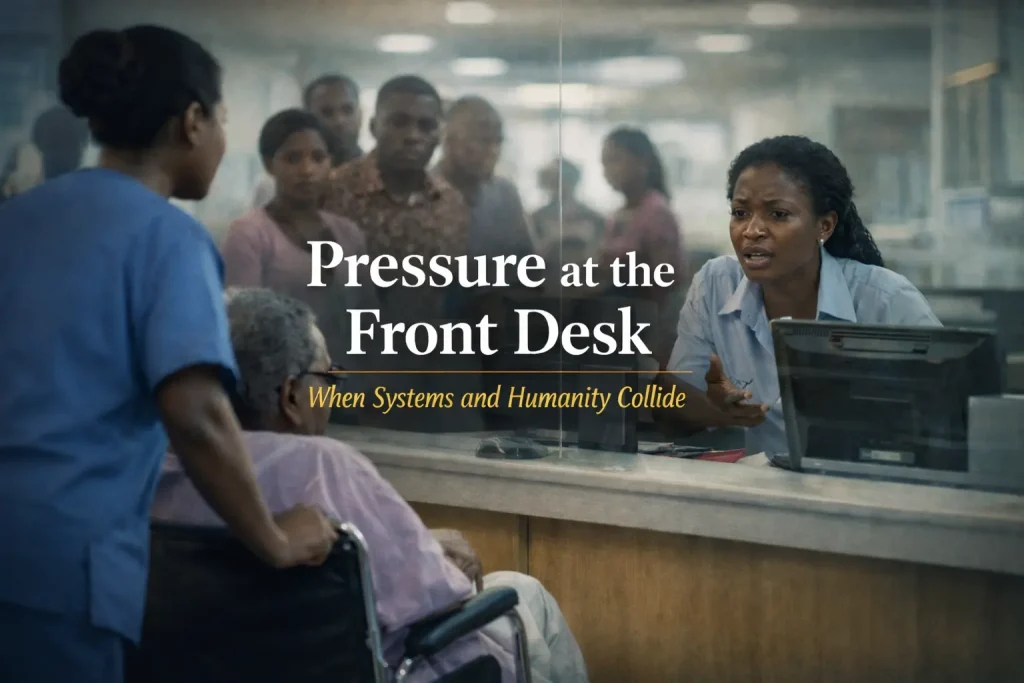
Pressure at the front desk is an invisible reality for many customer-facing professionals, especially in hospitals and public spaces where emotions run high and systems often strain under demand. Recently, while accompanying a family member through a hospital admission process, I witnessed a situation that clearly shows how customer care, policy, leadership, and human vulnerability collide — sometimes with dangerous consequences.
This experience reinforced a critical truth: front desk service goes far beyond following procedure. Instead, it requires navigating pressure, managing queues, calming fear, explaining policy clearly, and making human-centered decisions in moments that can escalate within seconds.
A Hospital Front Desk Under Pressure
At the hospital admission pay point, a teacher sat in a wheelchair wearing hospital clothes, accompanied by a young nurse. She looked visibly distressed. Meanwhile, a tense exchange unfolded between her and the customer care officer behind the enclosed payment window.
She had been admitted on 1st December, the same day the Kenyan government rolled out the SHA Comprehensive Cover for teachers. However, on 2nd December, hospital staff asked her to pay cash to proceed with admission under the new cover. Understandably, she felt confused. Why had no one explained this requirement on the first day?
On the other side of the glass, the customer care officer faced a different pressure. Procedures dictated one response, while the system displayed another. At the same time, the hospital had not issued clear escalation guidelines for a policy transition happening in real time.
As a result, both parties stood on valid ground — and both felt trapped.
Meanwhile, the queue grew longer. Anxiety thickened the air. My own patient, already unwell, became increasingly agitated, fearing that urgent care might be delayed. Eventually, under emotional strain and uncertainty, she nearly collapsed and had to be rushed back to casualty for stabilisation.
This moment revealed what pressure at the front desk truly looks like — unseen, relentless, and emotionally exhausting.
When Systems Change Faster Than Communication
Policy transitions play an important role in service improvement. However, organisations often fail at the point of execution.
In this case, leadership introduced a new insurance framework without equipping frontline staff and patients with clear communication. Consequently, front desk officers absorbed the shock of systemic gaps.
Every day, frontline staff face:
- Angry patients
- Conflicting instructions
- Long queues
- Medical emergencies
- Limited authority to override systems
Without proper training and escalation protocols, even empathetic staff can appear indifferent or incompetent. In reality, pressure overwhelms them.
This challenge closely reflects themes I explored in Customer Etiquette at the Front Desk, where clarity, tone, and patience determine whether situations de-escalate or spiral.
Pressure, Queues, and the Cost of Leadership: Lessons from Carnivore
This hospital incident also brought back memories of the Carnivore Nairobi stampede of December 2004.
According to documented reports, organisers expected about 15,000 attendees. Instead, far larger crowds arrived. Sixteen entry gates struggled to cope. Security teams rushed vetting, and age checks disappeared under pressure.
Eventually, impatience turned dangerous. People pushed. Others fell. By midnight, a stampede had claimed the lives of three young students.
What stands out is not the absence of security, but the overwhelming pressure of crowd management:
- Too many people
- Too few entry points
- Cheap tickets encouraging mass turnout
- Inadequate queue control
- Delayed leadership decisions
Frontline security staff, much like hospital customer care officers, absorbed public anger while lacking authority to close gates or redirect crowds. Leadership failed not because systems did not exist, but because those systems could not respond flexibly under pressure.
This reality mirrors the lessons I explore further in The Cost of Leadership.
The Human Toll of Serving Under Pressure
Serving long queues is never a mechanical task. Instead, it demands emotional labour.
Frontline workers must:
- Absorb anger
- Communicate unpopular decisions
- Enforce rules
- Maintain calm
- Protect safety
All the while, they remain watched, judged, and sometimes verbally abused.
In hospitals, the stakes rise even higher. Delays feel like neglect. Questions sound like accusations. Policies feel like punishment. Yet, as I discussed in Personalised Customer Care in Hospitals, patients do not only need efficiency — they need reassurance, explanation, and dignity.
What Better Front Desk Management Looks Like
To reduce pressure at the front desk, organisations must actively support frontline staff.
1. Clear Communication During Policy Changes
Leaders should support policy rollouts with:
- Staff briefings
- Patient-facing notices
- Temporary flexibility during transition periods
2. Clear Escalation Pathways
Front desk staff should never feel trapped. Instead, they need:
- Supervisors on call
- Authority to pause queues
- Clear exception-handling guidelines
3. Understanding Queue Psychology
Long queues increase aggression. However, simple actions reduce tension:
- Regular updates
- Visible signage
- Staff acknowledging waiting customers
4. Emotional Intelligence Training
Technical knowledge alone does not suffice. Staff must learn to:
- De-escalate conflict
- Listen actively
- Communicate empathy even when delivering difficult messages
Books such as Emotional Intelligence by Daniel Goleman and The Compassionate Healthcare Leader by Dr. Stephen Klasko offer valuable guidance for managing service environments under stress.
A Call for Grace — On Both Sides of the Desk
Pressure at the front desk rarely results from laziness or indifference. More often, broken systems, poor communication, and distant leadership decisions create it.
Therefore, as customers, patients, and leaders, we must remember:
- The person serving you is human
- The policy frustrating you may not be theirs to change
- Calm conversations save lives
Whether in a hospital hallway or at the gates of a crowded venue, how pressure is managed determines whether a situation stabilises — or turns tragic.
At Lobby Reflections, I document these lived experiences to help organisations build better systems grounded in empathy, clarity, and accountability.
Frequently Asked Questions About Pressure at the Front Desk
What causes pressure at the front desk in hospitals?
Pressure at the front desk often results from long queues, policy changes, staff shortages, system limitations, and emotionally distressed patients.
How can hospitals reduce front desk pressure?
Hospitals can reduce pressure by improving communication during policy changes, providing clear escalation pathways, training staff in emotional intelligence, and managing queues proactively.
Why do frontline staff absorb public frustration?
Frontline staff interact directly with customers but often lack authority to change policies, making them the visible face of deeper systemic challenges.
Call to Action
Pressure at the front desk is not theoretical. Frontline staff experience it daily across hospitals, offices, events, and public institutions.
If your organisation struggles with long queues, overwhelmed staff, policy transitions, or emotionally charged customers, intentional customer care training makes a measurable difference.
👉 I offer practical customer service training, front desk etiquette coaching, and leadership conversations on managing pressure in service environments.
📩 Reach out via lobbyreflections@gmail.com or WhatsApp 0746 011 448 to start the conversation.
Let’s build systems that protect both the people being served — and the people serving.
Leave a Reply